I was shy. And now?
Posted on August 13, 2017 • 5 min read • 994 words
I really sympathize with children and adults who are shy. I know better than anyone what it is to be shy. When we moved earlier, the neighbor across the street even thought that my mother only had three daughters. She had never seen me; I didn’t come out. I don’t know if you’ll ever really grow out of this, but you can certainly do your best.
When people don’t know me that well, I sometimes say that I am shy. They think that’s strange. ‘You shy? You don’t come across that way at all, I would never have thought that.’
And yet it is so. It is much better now than it was in the past, but I believe it will never go away completely. It is so wonderfully familiar, so wonderfully tucked away in your comfort zone.
Comfort zone
I haven’t done any in-depth research into it, but I think shyness is very closely related to your comfort zone. Your comfort zone is that where you feel comfortable and secure, where you have no fear. Everything you do that makes you feel safe and comfortable is part of your comfort zone. That comfort zone is different for everyone. For one person this is very small, for another it is very large. Ultimately, everyone still has that area in which they feel safe. That also means that you want to keep returning to your comfort zone. In any case, you know what to expect there.
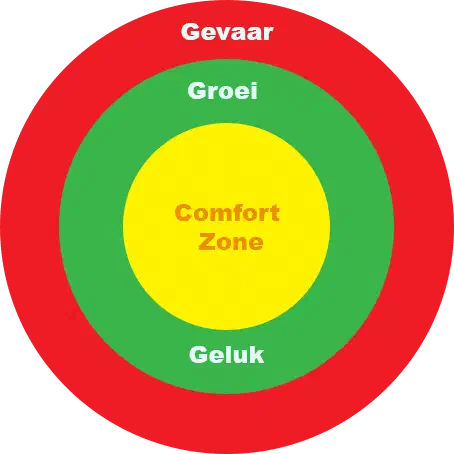
But if you look at the picture, you see that the actual learning and growth and the associated happiness happens outside your comfort zone. And even outside the growth area you experience danger and/or panic. Instinctively you want to return to your comfort zone.
I already said that I think shyness is a matter of being afraid to step outside your comfort zone, in this case interacting with other people. To reduce your shyness, you will have to step outside your comfort zone every now and then. And because you gain experience there, it will become part of your comfort zone.
How do I get rid of that shyness?
The question is: How willing are you to step outside your comfort zone? If you are fine with where you are now, don’t change anything. No one can, and should, convince you that it is better outside your comfort zone. This is something you can only experience for yourself. That was, and still is, also true for me.
Intentions
Resolve to challenge yourself. I still regularly have an instinctive tendency not to do things. Because to do so would mean stepping outside my comfort zone, which is scary. Often, but not always, I end up doing it anyway. Precisely by forcing myself to step outside my comfort zone.
Above all, resolve to continue challenging yourself. Once you stop stepping outside your comfort zone, it quickly shrinks. Eventually you become afraid of everything and even having a conversation with someone becomes too difficult to do.
Surround yourself with your opposites
I have been fortunate, or perhaps attracted, to have friends who were my polar opposites. Some were so bad that they verbally challenged me to stand up for myself for once (I assume you recognize yourselves if you read this). This not only allowed me to see how things could be done differently, what the results were, but I also received ’lessons’ in standing up for myself. I had to come out of my shell, otherwise the verbal abuse would continue.
I don’t mean to say that you should let yourself be bullied. Bullying is never Okay, no matter how old you are. If you are being bullied, do something about it. Ask for help.
Expand your knowledge
I have read a lot of books and listened to a lot of CDs. Knowledge is power, they say. I absolutely believe that.
A selection of the books I have read:
- This is how you make friends and good relationships – Dale Carnegie.
This book has been republished and is now called [How to Make Friends and People influences]( https://partner.bol.com/click/click?p=2&t=url&s=49599&f=TXL&url=https%3A%2F%2Fwww.bol.com%2Fnl%2Ff%2Fhoe-je-vrien den-makes-and-influences-people%2F9200000011708118%2F&name=How%20you%20friends%20makes%20and%20people%20influences%2C%20Da…) - [Small Talk – Debra Fine]( https://partner.bol.com/click/click?p=2&t=url&s=49599&f=TXL&url=https%3A%2F%2Fwww.bol.com%2Fnl%2F p%2Fsmall-talk%2F1001004007139324%2F&name=Small%20talk%20(ebook)%20EPUB%20with%20digital%20watermark…)
In addition, I have devoured many books on all kinds of subjects, from applicable IT books to biographies of Elon Musk, Bill Gates and Steve Jobs.
For a (by no means) complete list of books, see Goodreads .
Once you have the knowledge (in English the Subject Matter Expert or SME), you no longer have to worry about it.
Get a workout
There are training and courses for dealing with people. They may not be called that, but consider, for example, a course in ‘Complaint Handling’, ‘Train the Trainer’ or ‘Life Orientation’. A course to become more assertive is also not a waste of money in most cases.
I’ve done some of those workouts myself. I did a Train the Trainer course, which meant I didn’t have to stand alone in front of a group, but they expected me to tell them how things should be done.
Practice, practice, practice
Do what you don’t want to do: Be in the spotlight, talk to people. Before I did a lot of presentations, I found it very exciting. I was almost gagging when I had to speak in public, my heart rate rose to unprecedented heights and I broke out in a sweat. But I wanted to give my opinion or get my point across. This is difficult if you cannot or do not want to speak to other people. Fortunately, I was given the opportunity to give presentations and workshops for our colleagues. This made it a little easier.
Will I always be shy?
I think so. It is something that is deep within you, that is part of your habits. I’m no doctor, but I wouldn’t be surprised if it’s also part of your brain structure. After all, your brain is formed based on experiences and habits.