Water softener
Posted on October 31, 2017 • 6 min read • 1,078 words
Is a water softener actually necessary? Our drinking water is of good quality. Most drinking water in the Netherlands is extracted from the ground. The soil contains all kinds of lime layers. The deposition of crustaceans in the past in particular has ensured that the soil is still rich in lime. Water extracted from the soil therefore also contains lime from these layers.
Because drinking water is extracted from the ground in different places, the hardness of the water, the amount of lime in the water, also varies. The hardness of the water is expressed in German degrees and is shown as dH, which stands for “deutsche Härte”. 1dH is equal to 17.8 milligrams of calcium carbonate (CaCO3, or lime) per liter of water.
Water companies remove lime from the water to make it ‘softer’, but they cannot remove everything due to the technology used. When we talk about the hardness of the water we are talking about:
| dH | Water |
|---|---|
| 0-4 dH | very soft water |
| 4-8 dH | soft water |
| 8-12 dH | average water |
| 12-18 dH | quite hard water |
| 18-30 dH | hard water |
You can check how hard the water is in your area on the website of your water company, or at waterhardheid.nl . If you want to measure it yourself, you can do this with a test strip.
Consequences of hard water
Hard water is quickly visible, especially in the bathroom. Tiles and grout, shower wall and other sanitary facilities turn white or develop a white cast. This means that dirt and new limescale quickly deposits on tiles and sanitary facilities. In addition, shower heads suffer from all that limescale. To maintain a good, strong jet, the shower head must be descaled regularly.
Especially in places where water is heated, you quickly see limescale forming: on the heating elements
of hot water equipment, dishwasher, washing machine, coffee maker, kettle and so on. You can easily see it in your kettle. The limescale collects on the edges and even forms small stones in your kettle: scale. And let’s not even talk about (glass) surfaces not drying streak-free.
The more limescale deposits, the faster the appliances containing these heating elements break down. Even water pipes in your home slowly but surely lose their optimal flow capacity.
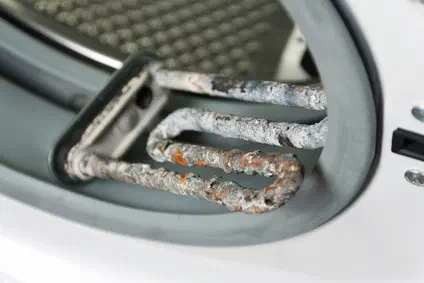
limescale on the heating element of a washing machine
The annoying thing is that limescale is difficult to remove. You can of course use all kinds of ‘aids’, such as boiling your kettle with vinegar, but it is only temporary. You will also have to use detergents for the washing machine and dishwasher to which anti-limescale agents have been added to combat limescale. The anti-limescale agents are often not good for the environment and they also attack joints and chrome and cause glass erosion.
All that lime is also not always pleasant for the human body. Yes, we need lime, but it is less for the skin. The skin dries out under the influence of lime.
Water softener
Fortunately, there is something you can do about all these problems: Install a water softener.
A water softener removes a large part of the limescale from the water, in some systems even to (almost) zero. This prevents limescale from depositing on heating elements, tiles and taps. It also has a number of other advantages:
- because there is no longer any lime on the heating element, less energy is needed to heat the water
- You also need less detergents, soap and shampoo, since the soap does not bind with lime in the water
- It is also said to be wonderful for people with skin conditions such as psoriasis and eczema, because the skin dries out less due to the lack of lime.
- Glasses and cups remain beautiful for longer because erosion of the glass no longer occurs.
- Your tea and coffee will taste different. Well, that doesn’t really have to be an advantage, of course.
Prejudices for water softeners
In the past, there were still some prejudices about water softeners. There are also assumptions made that are not entirely correct. A few are listed below:
Soft water is more corrosive than hard water
It has long been assumed that soft water is more corrosive than hard (calcareous) water. Hard water would be less acidic, making it less harmful to copper pipes or aluminum elements. Fortunately, the opposite has been proven by, among others, TNO .
We need lime in the water for our bones
Of course we need calcium for our bones, there is no doubt about that. Fortunately, we get enough lime / calcium through our diet. Products such as milk, butter, cheese and other dairy products provide us with calcium. Whole wheat bread, chocolate and fatty fish and seafood also contribute to the required calcium.
The
RIVM
has even stated that only 3.3% calcium and 1.1% magnesium of our recommended daily amount comes from our drinking water.
How does a water softener work?
The majority of water softeners work on the basis of ion exchange.
The water softener has a tank that is filled with special resins (resine). The (negatively charged) water from the water pipe flows along/through these resins as soon as you use water.
The (positively charged) calcium binds to the resins, so that the calcium is extracted from the water.
Once all resins are saturated, rinse with brine. This causes the resin to be ‘rinsed clean’. Bags or blocks of salt are used for this. This is called regeneration. Once the regeneration is finished, the whole process starts again.
The difference in water softeners is often in the details. One system uses a regeneration mechanism that uses two tanks, another uses one.
Another difference is how the salt is added. Some systems use large bags of salt, others use handy blocks.
In addition, there is a difference in the way the system regenerates. Some systems require electricity, which means that a socket must be placed near the water softener, while other systems work based on water pressure.
Example of a water softener
The video below is an example of a water softener. This specific model is from AquaCombi from Sneek.
The AquaCell water softeners work mechanically, i.e. without electricity. It is a volume-controlled water softener that adapts to water consumption.
Continuous soft water is achieved by using two cylinders, also during regenerations. The flow rate of the AquaCell is high at 3000 liters per hour, more than sufficient for a family home. Disclaim